Quadfence, Inc.  ·  Houston, Texas  ·  Pre-seed

A verdict, and the arithmetic behind it.

In December 2022 our founder bought a dental practice. Her accountant went through the books. Her broker handed her a page of census data: education levels, a gender split, a race breakdown.

Nobody could tell her how many dentists were already fighting over the same patients, or whether the neighbourhood turned over faster than she'd ever keep up with. She signed anyway. Most dentists do.

AiRadics is the tool she needed and is now building. It will tell a dentist whether a market can be won. Then, if they want us to, we go and win that market for them — and for nobody else in their territory.

Quadfence is the company underneath it. We build AI for decisions where being wrong is expensive, which means a recommendation is no use unless you can check it, see where it came from, and get the same answer twice. Dental is where we prove that. It is not where it ends.

178,000

US dental practices, mostly independent

under 5%

Largest share held by any operator in the dentists industry (IBISWorld)

4.3%

Of practices needed for a $1B outcome

What AiRadics is

An analyst and a production line, in one system.

Three things, and the reason for putting them in one place is the interesting part.

It reads the market

Before a practice opens or changes hands: how many dentists per capita already compete for the same patients, and how fast the households nearby turn over — the renter and apartment ratios that cap patient lifetime value however well the place is run.

Then what the payer mix on the ground actually is, against what the practice’s own book assumes, and which clinical services the competition has left alone. A CPA can audit the books. None of this is in them.

It reads the money

Once the practice is running, every channel reports in — Analytics, Ads, Business Profile, Local Services, call tracking, mailers. The model works out what each one is actually producing, what a patient costs through each of them, and where the next dollar earns most.

Not five numbers on a dashboard. An answer about which channel to feed and which to starve, for this clinic, in this market, this month — and then the budget moves.

Sometimes the next dollar is not another click. A household that has just moved has left its old dentist and has to choose a new one — a buying moment nobody is bidding on. Routing budget to a moment like that is a call an agency paid a percentage of ad spend has no reason to make.

It makes the work

The website, the landing pages, the ads, the images, the video — all of it generated, and none of it going live until it has cleared the governance gate: FTC advertising rules, ADA guidance, the advertising requirements of the state dental board, and Google’s stricter standard for health content.

Ads get rewritten, budgets get moved, pages get rebuilt. None of it arrives as a change order, because producing an asset costs us a fraction of what it costs an agency to have a person make one.

Every clinic is a spoke. The learning happens at the hub.

A single practice cannot tell you much on its own. Eighteen months of steady spend across two channels gives a model almost nothing to learn from, which is the reason marketing mix modelling has historically been something only large advertisers could buy.

So the hub does the learning. It sits above every clinic we operate and works out which patient segments and which market conditions actually pay — then pushes that down to the spokes. A clinic gets the benefit of every market we are in. Its own numbers never leave it, and never inform a competitor’s plan.

All of it stays where it belongs. Raw data lands in the practice’s own cloud project; only aggregated, surrogate-keyed segments cross into ours. If a practice leaves, the project, the warehouse, the history and the website are already theirs.

That is not a feature that arrives once we are large. It is the reason the method works at a single small practice at all, and the reason a competitor with one clinic cannot copy it however good their software is.

Why all three, and not one of them

An agency has people who can make the work but cannot honestly measure it. An analytics tool can measure but cannot make anything. That split is why a dentist ends up paying either for a report they cannot act on or for spend they cannot account for. In one system the analysis decides what to make — and making it is nearly free.

Why this founder

She is the customer.

Dr. Soujanya Maddipati has run Mi Smile Family Dental in North Houston since she bought it at the end of 2022. Medicaid, CHIP, Medicare Advantage, PPO. She still sees every patient herself.

She knows what the diligence covers and what it misses. A CPA reads the books properly. The seller’s software gives you real patient counts. Past that you're guessing: how crowded the neighbourhood already is, whether the families nearby stay long enough to be worth acquiring, what the practices around you already offer and what they don't.

Then came three years of paying agencies she could not hold to a number. They got paid whether she grew or not, and any of them could've signed the practice a mile away the following week.

Dentists buy from dentists. That's not a marketing line, it's how the profession works, and you can't hire it. Her public health degree turns out to be the useful one here: it is a training in reading populations, which is most of what this product does.

Full background →

FounderQuadfence
DDSUniv. of Colorado Denver
MPHUniv. of Oklahoma
Practice owner sinceDecember 2022
Payers servedMedicaid · CHIP · MA · PPO
Patients seenpersonally, every one
Pilot practiceher own

A physician director covers the adjacent medical-practice vertical. An in-house engineering lead is the first hire this round funds.

The market

A $1B outcome needs 4.3% of one fragmented vertical.

Each number below is a count of practices multiplied by what one pays us in a year. We haven't borrowed anything from a bigger adjacent market to make it look larger.

$2.88Bgross market

178,000 US practices at a $16,200 annual contract value. Recurring fee only — media runs on the practice’s own accounts and is excluded.

$1.87Bserviceable

Independent practices only. We assume 65% remain independent, and affiliation is reported at 13–16% today. We have deliberately left small and mid-size DSOs out of this number even though they are buyers too, which means consolidation is less of a risk here than the figure implies.

4.3%share required

7,716 practices at $16,200 is $125M ARR, which is roughly a $1B company at an 8× multiple. We would be the largest player in this niche and still hold four percent of it.

We don't have to win this market, only a slice of it. The three largest dental marketing agencies we can put a number to serve roughly 9,100 practices between them, which is 5.1% of the market. The leader has 4.2% after twenty-three years and private-equity backing. Sizes and sources are set out below. The engine itself doesn't care that the customer is a dentist, which is why small medical practices are the obvious second move. Same shape of problem, different vocabulary.

Every figure on this page is sourced, dated and set out with its limits — including where our own assumptions differ from the published comparables. See the market evidence →

How revenue is generated

One payment to meet a practice. Then the part that recurs.

Only the subscription is ARR. We are not going to dress the evaluation fee up as revenue that repeats. A dentist about to sign for a practice already has to answer the question we sell the answer to, so we get paid to find our customers rather than paying to find them. Most software companies would take that trade.

01 · acquire

Market evaluation — one-time

Before a dentist signs for six or seven figures, somebody has to tell them whether the market holds up. We do, for a fee small enough that agreeing to it takes about a minute. It roughly covers what the market data costs us, so it isn't where we make money. What we keep either way is a working model of that neighbourhood, whether or not they come back.

02 · included

We build the website. No charge.

Built from the intake we already have, HIPAA-ready, and theirs to keep whatever happens between us. Every agency in this business sells a website for four or five thousand dollars and then bills to maintain it. We give it away because the engine needs somewhere for patients to land, and because a practice that has already been sold a website it cannot measure does not need another invoice.

03 · the recurring part

The engine — recurring, exclusive

Now we run their patient acquisition, and we make the work rather than co-ordinating it: the website, landing pages, ads, images and video, all generated and all governance-checked, alongside search, Google Business Profile, rankings and local presence. One thing instead of five invoices. One practice per territory, written into the contract. $16,200 a year, and their ad budget stays in their own accounts. This is the only line that is ARR.

Small and mid-size DSOs are customers, not competitors.

A group with five to thirty offices has the same problem an independent has, multiplied. Too large to run on an owner’s instincts, too small to carry a marketing department, and usually assembled by a clinician who now owns twelve profit-and-loss statements they cannot compare. One contract, many locations, one signature instead of twelve.

Because the rate is the same per office either way, consolidation costs us nothing in revenue — a group’s twelve offices pay exactly what twelve independents would. What changes is the effort: one conversation instead of twelve, and a far lower cost to win each office.

The real constraint is territory, not price. Exclusivity is a per-zone promise, so a group with twelve offices in one metro consumes twelve zones and closes them to the independents who match on all three conditions. That cuts the other way too: an independent already under contract blocks a group deal in its catchment. We sequence around it rather than pretend it is not there.

None of this is in the market figures above. It is upside we have chosen not to count.

The ARR ladder

100 practices$1.6M ARR
500 practices$8.1M ARR
1,900 practices$31M · ~$250M company
7,716 practices$125M · ~$1B company

Growth comes from adding sales agents on commission, not from adding overhead. The software tells each of them which practice to call next, and which ones are already spoken for.

Why they stay

  • We only grow when they grow. Exclusivity means we cannot make up a bad month by signing the practice down the road. The people we compete with are the marketing roll-ups buying up agency books, not the dental groups — those are customers.
  • Buying power. We negotiate software the way a group does, and pass the rates down to practices that could never get them alone.
  • Everything we build next — the patient-facing apps in particular — sends people back to their site rather than ours.
  • Two years of knowing what worked in their specific neighbourhood doesn't come with them to the next agency.
  • No annual contract, on purpose — ninety days’ notice either way, and nothing longer. If it stops working we will say so rather than quietly billing them for another year.

Two numbers decide whether any of this works, and we don't have either one yet: how many evaluations turn into subscriptions, and how long a subscription lasts. Finding both out is what the first group of practices is for, and the evaluation price will almost certainly move once we have. Giving the website away is a real cost of delivery rather than a rounding error, and it is priced into the model on that basis.

The cold-start question

Why would a dental clinic fire its marketing agency and subscribe to AiRadics?

Every clinic already pays someone to do this, so the honest question is not whether they need it but why they would change supplier. We have split the answer in two. Some of what makes us better only becomes true once a few hundred clinics have signed, and those reasons cannot win us our very first customer, so we are not going to lean on them.

True from the first practice

These are structural or contractual. They do not need scale.

  • We will not sign their competitor. Written into the agreement. An incumbent agency cannot promise the same thing without capping its own revenue and dropping clients it already bills. A private-equity roll-up cannot promise it at all, having already bought agencies that serve both sides of the same street.
  • No change orders. Adding a photo, swapping a video, editing a page: today that means emailing an account manager, waiting, and often hitting a monthly cap on edits. Producing an asset costs us a fraction of what it costs an agency to have someone make one, so there is no cap and no invoice. That is architecture rather than generosity.
  • Every channel, for what an agency charges for two. Agencies quote $1,200 to $1,500 a month to run Google and Facebook ads and nothing else. At that price we cover search, Business Profile, paid, rankings and local presence — and we will tell a practice to spend less on a channel when the next dollar belongs elsewhere. An agency paid a percentage of ad spend cannot give that advice.
  • Their data never leaves their own cloud. Ad platforms and patient records are a contested boundary and most dental agencies are not built to think about it. We set the practice up in its own project: raw data from Analytics, Ads and call tracking lands there and stays there, and only aggregated, surrogate-keyed segments move to us. It is a boundary in the architecture rather than a promise in a policy — which is also why we could not hand a competitor their numbers even if we wanted to.
  • Time with a human who knows the practice. Because the platform handles the production work, the people are spent on the practice rather than on ticket queues.

Only true once we have scale

Real, and we will not pretend they are available yet.

  • Group purchasing. A few hundred practices buying together get software rates a single clinic never will, and we pass them down. At one practice we have no leverage at all.
  • What worked somewhere else. The mix model borrows from every comparable catchment to make sense of one clinic’s thin data, and what performed in one market informs what we produce in the next. Patterns cross practices. A client’s own numbers never do.
  • Machine learning across the network. The same mechanism as the point above, further out. Its value rises with the number of markets we operate in, which today is one.

That is also why the evaluation matters beyond its fee. Each one we run adds a catchment model whether or not that practice becomes a client, so the network begins compounding before the client base does.

On patient data we are making a design statement, not a compliance claim about anyone else. The regulatory position is set out on the evidence page.

Who we sell to, and how we part

One rate, a real qualification bar, and ninety days either way.

Independents and small groups, at the same price

A single rate whether a practice stands alone or belongs to a group of twenty. Volume does not get a discount and it does not pay a premium, which makes the negotiation short.

The comparison a group actually makes is not against hiring someone — it is against what they pay today. A twelve-office group typically has an agency on retainer and a marketing director whose job is to hold that agency accountable, and dental marketing directors run $58,000 to $90,000 before benefits. We displace the retainer and give the director the channel-level numbers their job description asks for. That works at five offices and it still works at twenty-five.

Above roughly thirty offices a group can justify a full in-house department and the arithmetic turns. We are not pretending otherwise, and those groups also come with procurement cycles we do not want yet.

Exclusivity is narrow on purpose

A practice only counts as a competitor if all three are true: it sits inside the same zone, it serves the same primary age group, and its top revenue service falls in the same category. Two out of three is not a conflict.

That matters commercially. A blunt promise would lock up a whole metro on the first signature. A three-part test lets a paediatric practice and an adult general practice share a zone, and lets us serve a group of twelve without shutting the door on every independent nearby.

We choose our clients, and we say why.

Marketing brings the phone call. Somebody still has to answer it. A practice that misses half its calls, never replies to a review, or will not give us access to its own numbers will make the engine look ineffective — and with no track record yet, we are the ones who get judged for it.

So we assess whether we can actually help before taking a practice on, and we say so when we cannot. Where the problem is fixable we set it out plainly, give it six months with support, and review it against the things we agreed to measure. If it has not moved, we end the engagement rather than keep billing for work that cannot land. It is the same courtesy any employer owes: tell someone what is wrong, help them fix it, and be honest if it does not.

For an investor this is a margin and reference question, not a philosophy. Our unit economics depend on the engine producing results, and our first ten case studies decide how fast the next hundred practices sign. Both get worse if we take money from clinics we cannot help.

Ninety days, and it runs both ways

Either side can end the engagement on ninety days’ written notice. No annual lock-in, no automatic renewal, no penalty. Ninety days is long enough to hand over cleanly and short enough that nobody feels trapped.

A performance review is the one exception: where we have set out a problem and given six months to fix it, the engagement ends at the close of that period rather than starting a fresh ninety-day clock.

And their territory stays protected afterwards

Exclusivity does not lapse the moment a practice leaves. Their zone stays closed for ninety calendar days after the engagement ends, and they get written notice before we approach anyone in it.

Exclusivity applies to active paying subscribers and to ongoing marketing only. A one-off market evaluation carries no territory rights — a practice buying a report is buying an answer, not a claim on a market.

The recurring product · how it works, and why the margin holds

What a dentist is meant to see.

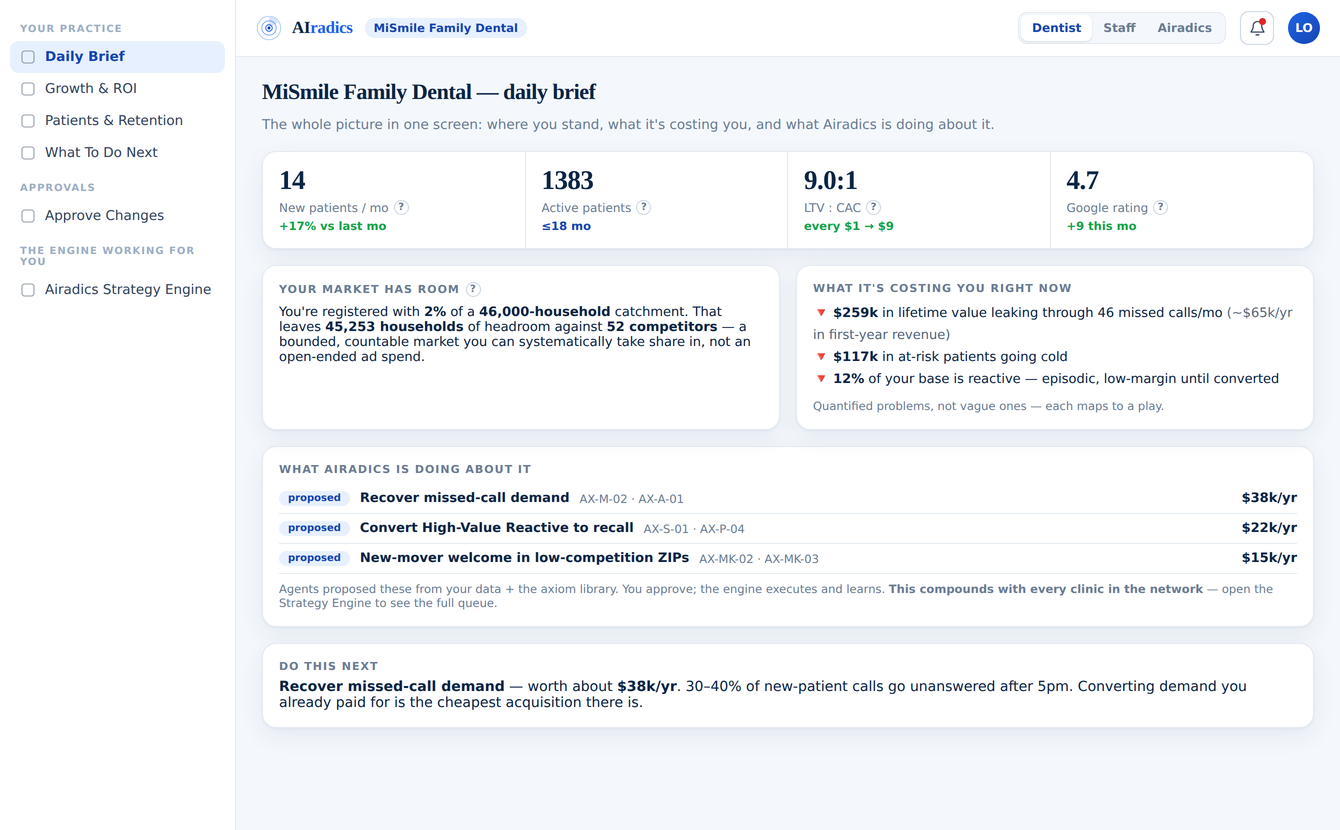
Where the money is going out the door, in dollars, next to the specific things we plan to do about it and whether they worked. An agency dashboard can't show a dentist this, because an agency doesn't have a model of their neighbourhood to compare them against.

This is a design, not a running product. It is here so you can see what we are aiming at rather than take our word for it.

Development build of the AiRadics practice console: a daily brief showing new patients per month, active patients, LTV to CAC ratio, catchment headroom against competitors, quantified revenue leakage, and proposed plays awaiting approval.
Practice console · daily brief Development build · sample data

A development build with sample data. Nobody is using this yet, including us. The product is still being written.

What produces the recommendations

Underneath is a marketing mix model, and there is an awkward fact about running one for a small business: a single clinic’s history is too thin to learn from. Eighteen months of steady spend across two channels gives you almost no variation, and a model needs variation to tell you what worked.

So it borrows. Every comparable catchment in the network informs the estimate for a new one — wide confidence intervals at the first clinic, tighter with each clinic after. That is not a benefit that shows up once we are big. It is the reason the method works at all, and it is why a competitor with one clinic cannot do this however good their software is.

What produces the work

Everything a practice needs is generated: the website, the landing pages, the ads, the images, the video. Nothing reaches a patient until it has cleared the governance gate — FTC advertising rules, ADA guidance, the advertising requirements of the state dental board, and Google’s standard for health content, which is stricter than for most subjects.

That last one matters more here than people expect. Google treats anything touching health or money as a category where thin material gets buried, so generated dental copy that reads as generated tends not to rank. Producing content that satisfies that bar reliably, at volume, is most of the engineering.

And it is where the margin comes from. An agency pays a person to make each asset. A competitor generating everything from scratch pays for it every time. Ours costs a fraction of either. That architecture is the difference between costs that rise with every client and costs that do not, and it is not something we describe in public.

Pre-product · in build

The product is still being built. That is the honest position.

Three interfaces exist as working development builds: the one a sales agent would use, the one our analyst would use, and the one a practice would see. We are pulling real marketing data out of our own clinic through Google Ads, Business Profile, Search Console and Analytics. The reasoning engine behind all of it, and the dental model it reasons over, are still being written.

Nobody is running on this yet, us included. The founder’s own practice will be the first place we try it, and that is a starting point rather than a customer. We are not going to call it one.

Twelve provisional patent applications filed and assigned to Quadfence, covering multi-model consensus and deterministic replay, governance compilation, cryptographic provenance and privacy-preserving federation. Prior-art review determines which convert.

The software is being built for us by an engineering firm run by the founder’s husband. Worth saying plainly rather than having you find it later: Quadfence owns the IP outright, the work has an end date and a full handover, and you're welcome to read the agreements.

Raising a pre-seed round.

The deck has the market built up practice by practice, the operating model, an honest look at who else is in this, and the questions we expect you to ask. If a two-page memo suits you better, say so and we'll send that instead.

Request the deck

If you run a practice in Texas and you are thinking about opening or buying, or you're paying an agency and can't tell what you're getting for it, write to the same address. We are only taking on a few to begin with.